In new book, AUM Professor explores the evolutionary pathways of a changing global order
Will we always live in a world where every state controls its territorial rights, sovereignty and sense of stability within established mechanisms of order that are legitimately recognized by other states and agents?
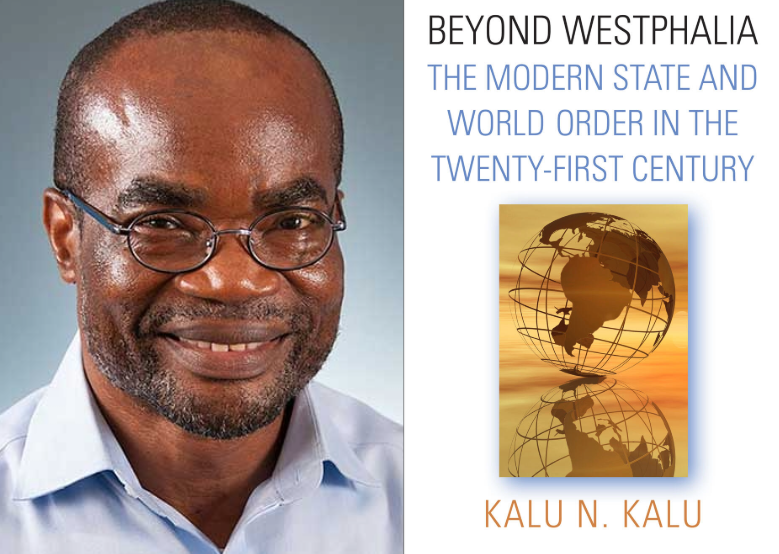
Auburn University at Montgomery Distinguished Research Professor of Political Science and National Security Policy Kalu N. Kalu explores that question in his new book, “Beyond Westphalia: The Modern State and World Order in the Twenty-First Century.”
Kalu’s 444-page book examines how the modern system of independent states developed, the challenges it faces today, and how major changes around the world could lead to a different global order.
For more than three centuries following the signing of the Treaty of Westphalia (1648), scholars of international relations have largely viewed the Westphalian state — a strictly bounded territory ruled as a single, sovereign supreme authority — as a permanent fixture of global sociopolitical organization. In his book, Kalu challenges that assumption, arguing that Westphalian statism is only a stage in an enduring evolutionary process of social and political change as has always been the case throughout history.
“The modern state will not last forever, just as the empires, kingdoms, and political systems before it did not,” he said. “History shows that political systems are always evolving, and new forms will continue to emerge. The book is therefore an ‘eye-opener’ not only about the evolution and transformational trajectory of the modern state, but also a prognosis for where it is heading, as well as the impulses that drive it.”
“One of the biggest challenges facing modern society today is the breakdown of political and social order, the evolving character of political attitudes, and the sharp, almost abrupt disengagement between traditionalism and modernity. When a state struggles to maintain that order, the stability of the entire system and its institutions is at risk.”
Specifically, Kalu points to challenges currently facing international institutions, including the United Nations and tensions between governments and groups that challenge their authority. He also raises concern about conflicts over governmental authority and how laws, or lack thereof are being enforced in the United States currently.
“We cannot continue to govern this way, and as these systemic ruptures and fissures continue, the modern state system itself could eventually unravel,” he said.
Kalu’s book is a layered and unsparing autopsy of the Westphalian system, asserting that the nation-state is not the definitive end of political evolution, but a transient and evolving historical phase. Focusing on the two theoretical foundations evolutionary social change and Giddensian structuration theory — which asserts that human agency and social structures are not separate or opposing forces, but constitute a duality — the book begins by examining the developmental history of the modern state system. It goes on to examine the role of the Hapsburg/Holy Roman empire, feudal enclaves, princely fiefdoms, principalities and the end of the Thirty-Years War in the evolution of modern European political culture and its spread throughout the international system following the end of World War II.
Kalu’s book also addresses the debate over how sovereignty, mutual recognition, legal equality and secularity intersect with the ideals of influential thinkers such as Hugo Grotius, Thomas Hobbes and Emer de Vattel concerning the natural law of nations and its impact on the exercise of legitimate authority.
Building on constructivist social theory in international relations (IR), which asserts that global politics is shaped by the ideas, interests, beliefs and experiences of political actors, Kalu argues that the rapid and increasing scope of variation in which world events have been changing in the past few decades will drastically transform Westphalia ontology, the worldview treating sovereign states as primary actors on a global stage. This transformation could ultimately lead to modern states giving way to smaller, more localized forms of sociopolitical organization, such as tribal and clan-based systems.
“Beyond Westphalia: The Modern State and World Order in the Twenty-First Century” will be published Jan. 1, 2027, by State University of New York Press.
About the Author
Kalu N. Kalu is a Distinguished Research Professor of Political Science and National Security Policy at Auburn University Montgomery, docent professor at Tampere University in Finland and a Fulbright scholar. His academic career includes serving as a research affiliate at Yale University’s Whitney and Betty MacMillan Center for International and Area Studies and as a postdoctoral fellow at Yale University and the Yale University School of Medicine. He also has held research and academic appointments focused on international affairs, national security, counterterrorism and intelligence. Kalu is also the author of “A Functional Theory of Government, Law, and Institutions,” which received a CHOICE Outstanding Academic Title award.