AUM researcher receives NIH grant to study how cellular energy powers brain health
How does the brain power itself?
Auburn University at Montgomery researcher Siva Sakamuri, an assistant professor of chemistry in AUM’s College of Sciences, recently received a $249,818 National Institutes of Health grant to study how cellular energy production influences aging, cancer, neurodegenerative disease and overall brain health.
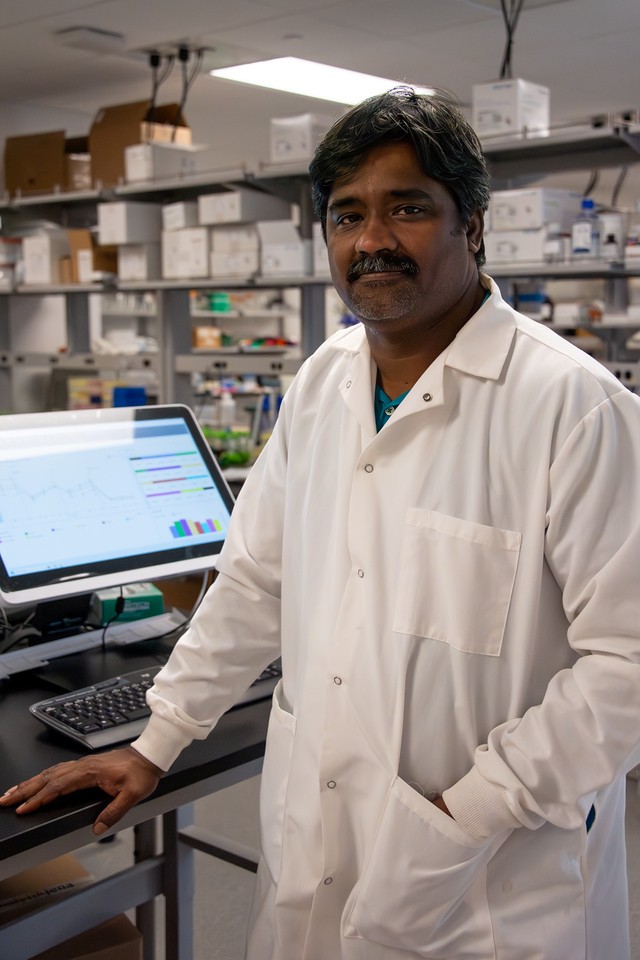
With funding from the grant, Sakamuri acquired AUM’s first Seahorse XFe24 Metabolic Flux Analyzer, a sophisticated instrument that measures cellular energy metabolism in real time, to support his research. The analyzer is among only a limited number of similar systems in Alabama, with comparable instruments primarily located at larger research universities in the state.
For Sakamuri, the technology opens the door to new questions about how changes inside cells may contribute to disease progression, particularly in the brain.
Working with an interdisciplinary team of researchers at AUM and Tuskegee University, Sakamuri hopes to better understand how cellular energy influences brain health and disease. Co-investigators on the NIH grant include AUM faculty members FNU Shivakant, Benedict Okeke, Douglas Leaman and Pryce Haddix from AUM’s Department of Biology, along with David Ro from the Department of Chemistry. The team is also collaborating with Balasubramanyam Karanam of Tuskegee University.
“We are interested in understanding how changes in cellular energy production contribute to aging, neurodegenerative diseases and other pathological conditions,” Sakamuri said. “By studying how cells generate and use energy under both healthy and disease conditions, we hope to better understand what drives dysfunction and identify pathways that could eventually lead to therapeutic intervention.”
At the center of Sakamuri’s research are brain endothelial cells, specialized cells that form the blood-brain barrier, a protective system that regulates what enters and exits the brain. While neuroscience research has traditionally focused heavily on neurons, scientists are increasingly examining how surrounding support cells influence cognitive health and disease, Sakamuri said.
“What particularly drew me to these cells is that their energy metabolism remains relatively underexplored,” he said. “Our research showed that brain endothelial cells rely more heavily on mitochondrial energy production than many other endothelial cell types. That raised important questions about how their metabolism changes during aging and disease.”
The Seahorse Analyzer will allow the researchers to study those changes in ways that were previously difficult to do using existing research equipment in university laboratories.
In simple terms, the Seahorse Analyzer helps scientists observe how living cells produce and consume energy in real time, a process Sakamuri compares to how different vehicles use fuel.
“Just as some cars run mainly on gasoline, some on electricity and hybrids can use both, cells also rely on different energy-producing systems depending on their needs and environment,” he said.
Cells generate energy primarily through two pathways: mitochondrial oxidative phosphorylation, which is highly efficient, and glycolysis, which provides a faster source of energy during stress or increased demand. The Seahorse Analyzer measures oxygen consumption and proton production in living cells, allowing researchers to determine which energy pathways cells are using and how efficiently they are functioning.
This information is especially important because many diseases alter how cells produce energy, Sakamuri said.
“In cancer, diabetes, cardiovascular disease and neurodegenerative disorders, cells often reprogram the way they generate energy,” he said. “Understanding those changes can help scientists better understand disease mechanisms and identify new therapeutic targets.”
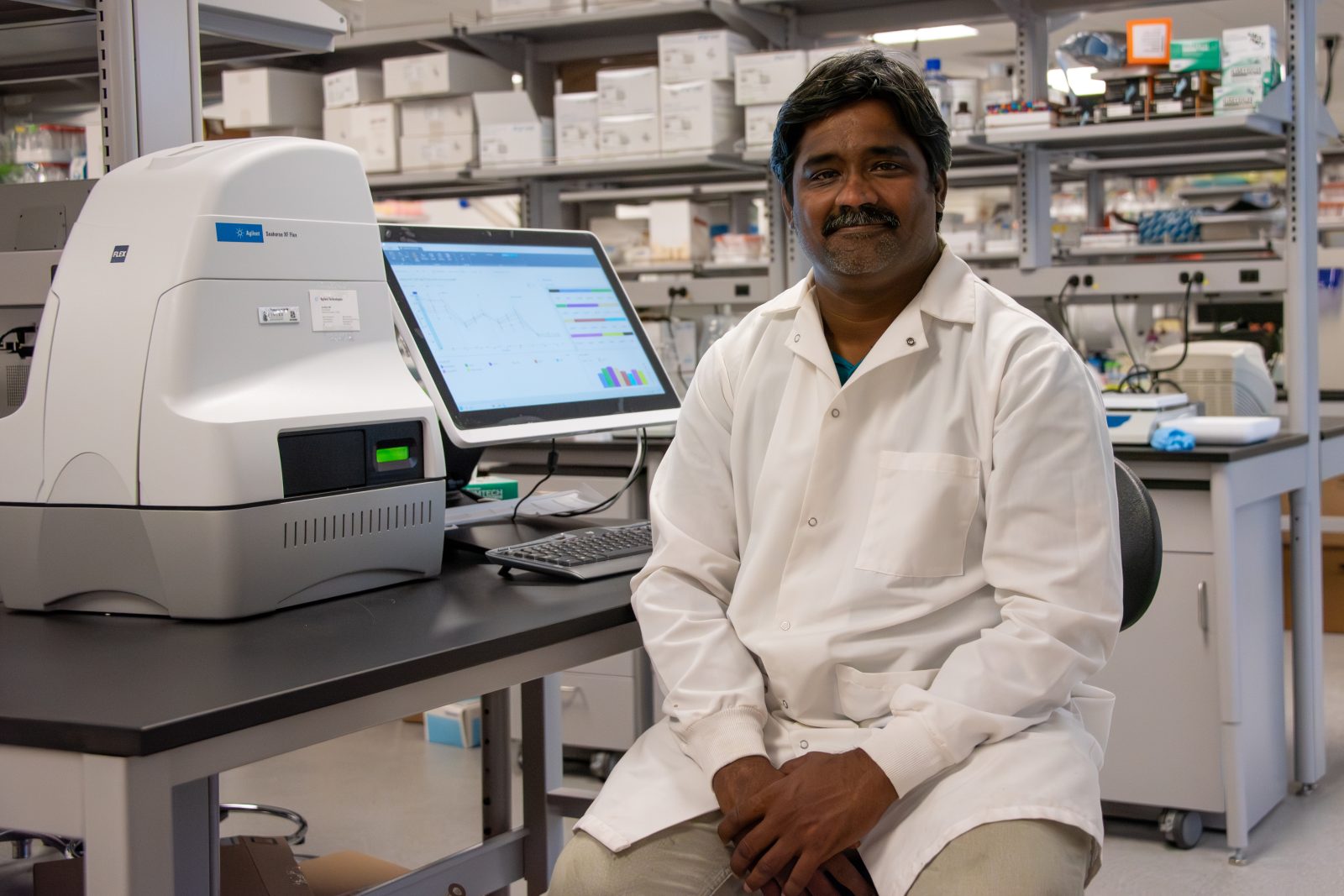 Additionally, the Seahorse Analyzer can analyze living cells, tissues and biological samples while providing dynamic, real-time metabolic measurements across multiple samples simultaneously, something older laboratory methods could not easily accomplish.
“Traditional approaches often provide only endpoint snapshots,” Sakamuri said. “The Seahorse Analyzer allows us to directly monitor how cells shift between energy-producing pathways in real time under physiological and disease conditions.”
Beyond the study, Sakamuri wants the Seahorse Analyzer to serve as a shared research resource at AUM, creating opportunities for additional interdisciplinary collaborations while strengthening partnerships with nearby colleges and universities.
“This technology significantly expands the types of experiments we can perform,” he said. “It enables more mechanistic and physiologically relevant studies while accelerating collaborative research efforts.”
Additionally, the data generated using the Seahorse Analyzer will help faculty compete for future grants from agencies such as the NIH and National Science Foundation while supporting peer-reviewed publications and long-term scientific discovery. It also will strengthen AUM’s growing role in biomedical research and innovation.
“As AUM researchers publish impactful findings and help solve important biomedical problems, the university gains recognition as an institution actively advancing science,” Sakamuri said.
Over the next several years, Sakamuri hopes the research will deepen scientific understanding of how brain endothelial cells function in both healthy and diseased states and help position AUM as a contributor in fields such as metabolism, vascular biology, neuroscience and aging research.
“Ultimately, I hope this work leads to new mechanistic insights and informs future therapeutic strategies for diseases linked to metabolic dysfunction,” he said.